It’s been one month since the Online Safety Act came into force in the UK and Ipsos has been watching as industry tries to put policy into practice – often with mixed response 👇
In general, users in the UK are onboard with regulation: Ipsos research finds that 7 in 10 support age verification checks on platforms with adult content, with support from voters across the spectrum.
However, this support in principle does not translate into a widespread willingness to comply as just half of Britons (48%) say they would be likely to submit proof of age to access a website.
Industry is struggling to find a one-size-fits-all approach to age verification, which is required across any UK site and platform with adult content:
🤳 Some sites, like Reddit, are asking users to verify their age via 3rd party platforms using an uploaded selfie or government ID, but 61% of Britons are concerned about their data privacy
💳 Steam users in the UK will now have to provide credit card details in order to access store pages for games with mature content. In the UK, you must be at least 18 years old to own a credit card, with Valve stating this process ‘preserves the maximum degree of user privacy’
😓 But this raises other issues of access and safety as UK consumers turn their back on credit in the face of ongoing cost of living challenges and fear of overreliance on debt, meaning those without access to a credit card risk missing out
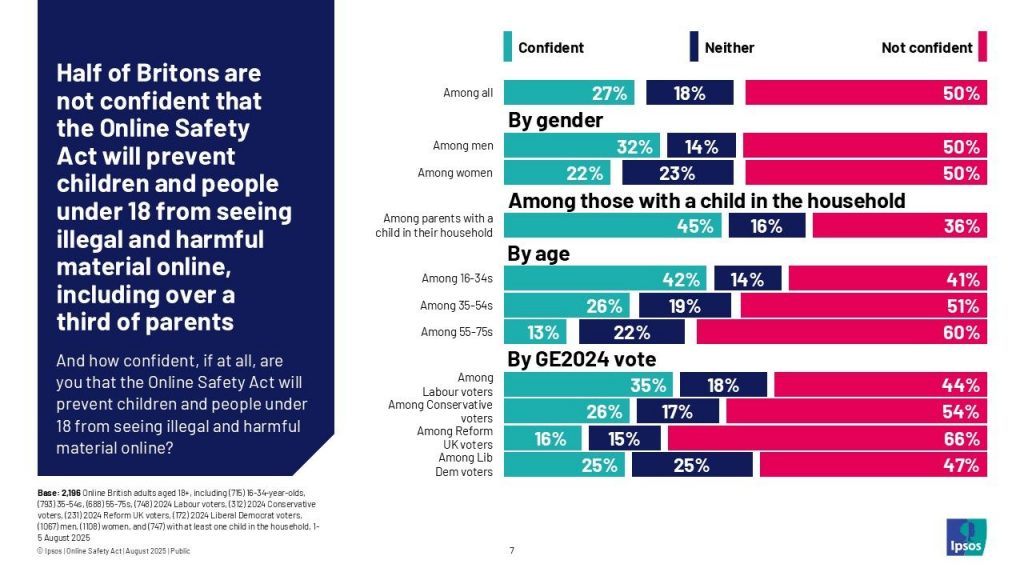
Online safety legislation may also have other unintended consequences on user’s online behaviour with 51% of Britons concerned the Act may have an adverse effect:
🗣️ A majority say it will lead to people’s personal data being compromised (61%) and government censorship of online content (58%). In contrast, there is much less belief that the Act will reduce cyberbullying (31%) or make platforms effectively remove illegal content (37%)
👥 There’s potential the Act could accelerate the fragmentation of the social media landscape as some users prefer the safety of a moderated online environment while others seek more permissive spaces that champion free speech principles
👣 This could further erode the reliability of data advertisers rely on as UK users turn to VPNs to evade safeguarding procedures, creating ‘ghost audiences’ that are difficult to target and track: 22% of Britons currently use a VPN, with a further 22% saying they have used or considered using a VPN since the Act’s announcement
If you want to learn more about UK users response to the Online Safety Act, check Ipsos’ recent research into the public response in the comments or get in touch to explore how we can help you understand impact on your business!